Malaysia farm-in opportunity – Seascape Energy Asia – Temaris Cluster SFA PSC
(Originally published on August 12, 2026)
The Temaris Cluster SFA PSC presents a pre-FID farm-in opportunity offshore Peninsular Malaysia. Seascape Energy Asia currently holds 100% and operatorship, with the initial development focused on the Tembakau gas field, which has certified 2C gas resources of 246 Bcf. The wider cluster also includes the smaller Mengkuang discovery, taking total certified Temaris 2C resources to 276 Bcf, with Seascape also highlighting material near-field exploration upside.
Key facts
- The Temaris Cluster SFA PSC was awarded in June 2025.
- The current participating interests are Seascape Energy Asia (100% + operator).
- The Temaris Cluster SFA PSC contains two gas discoveries: Tembakau and Mengkuang.
- The Tembakau field has certified 2C gas resources of 246 Bcf, and the Mengkuang field has certified 2C gas resources of 29 Bcf, independently audited by Sproule ERCE.
- Seascape is currently progressing the development plan for the Tembakau field, with first production targeted during 2028 and plateau production of 100 MMscf/d.
- Seascape has identified near-field prospects that could be developed from the planned facilities.
- In addition, Seascape has identified exploration prospects in both the Temaris Cluster SFA PSC acreage, as well as the contiguous PM-507 exploration block.
- Seascape has mandated Macquarie to structure and arrange debt financing for the Temaris and DEWA developments, although no firm financing has yet been announced.
The Temaris Cluster SFA PSC
The Temaris Cluster DRO was offered in February 2025 as a part of the MBR 2025 bid round, and was awarded to Seascape Energy Asia in June 2025. There have been no changes in ownership since, with Seascape holding 100% interest and operatorship. The cluster is located about 115 km east of Kerteh, offshore Peninsular Malaysia, in shallow waters about 70m deep. Geologically, the field sits in the Malay Basin.
The acreage covered by the cluster formerly sat in PM-307, which was operated by Lundin (now IPC). The two fields now included in the Temaris Cluster SFA PSC were discovered by Lundin between 2012 and 2015:
- Tembakau: Lundin drilled the Tembakau-1 exploration well in 2012, which resulted in a natural gas discovery in two Miocene sandstone intervals. The discovery was successfully appraised with the Tembakau-2 well in 2014.
- Mengkuang: the Mengkuang-1 well was drilled in October 2015 to test an oil prospect in the I-35 channel system. However, the well resulted in a small natural gas discovery.
IPC reported that a gas holding area (GHA) covering the Tembakau and Mengkuang fields was approved in 2017, but this expired in May 2021. PM-307 now consists of the acreage surrounding the Bertam oil field that has been producing oil through an FPSO since 2015, with IPC currently holding 100%.
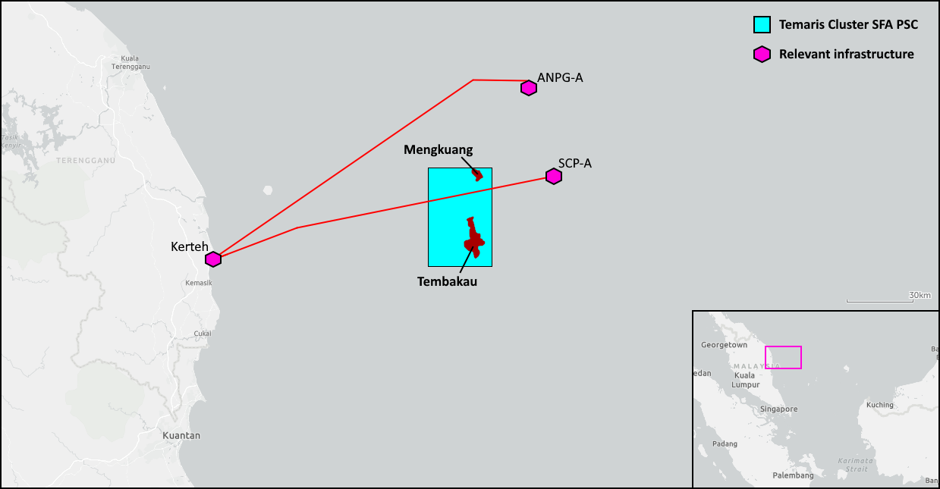
In terms of nearby infrastructure, there are two potential tie-in points for the Temaris gas: the Sotong Collector Platform (SCP-A) and the Angsi field. The Sotong Collector Platform is 40-50km from the Tembakau field and could provide compression and export through the existing pipeline to Kerteh. The Angsi field is about 65-75km from the Tembakau field, with a platform complex consisting of a central processing platform (ANPG-A) and a number of wellhead/drilling platforms. ANPG-A could provide both processing and compression prior to export through the existing pipeline to Kerteh.
Visible development plans – Tembakau field
Seascape has reported that the field development planning is underway for the development of the Tembakau field, with FDAP submission targeted for Q4 2026, around 18 months from award. Malaysia’s Agile Energy is currently undertaking FEED work for the development.
The reported development plan is based on the development of 246 Bcf of 2C gas resource, with the development plan seeing two wellhead platforms installed in the field, with the gas sent to (as-yet-unnamed) existing infrastructure. Seascape is targeting first production in 2028, with a plateau rate of 100 MMscf/d.
Seascape has also identified on-block exploration prospects totalling 950 Bcf, including around 120 Bcf of near-field prospects that could be drilled from the planned Tembakau facilities. In addition, Seascape has also identified prospects in the contiguous PM-507 exploration block that was also offered as a part of MBR 2025 and is yet to be awarded. The export pipeline for the Tembakau field is being planned with this potential upside in mind, in terms of both the routing and the capacity of the pipeline.
Our valuation model
We have created a discounted cashflow (DCF) valuation based on the visible plans and a number of our own assumptions, with these summarised below.
Fiscal model
The Temaris Cluster SFA PSC was awarded under Malaysia’s Small Field Asset (SFA) fiscal terms. These terms have been designed by MPM to facilitate effective monetisation of small fields. The terms are simple, and remove some of the regulatory burden of Malaysia’s normal R/C terms. A simplified flow diagram of the terms is shown below:
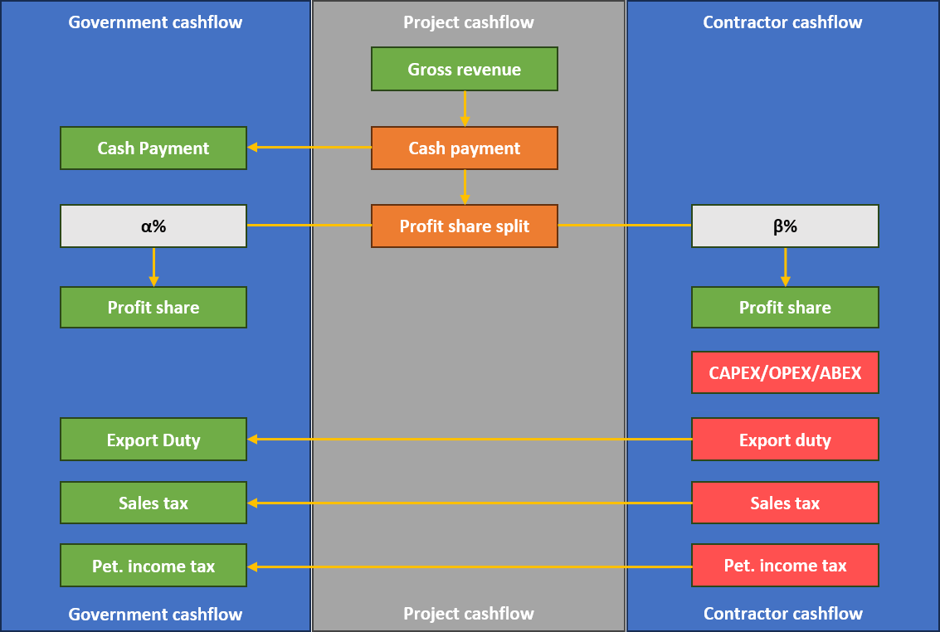
Within our model, the main assumptions are:
- Cash payment = 10%
- α = 10%
- β = 80%
- Export duty = 0%
- Sales tax = 0%
- Petroleum income tax = 25%
Production assumptions
Our model is based on developing the published 2C gas resource of 246 Bcf. We have used Seascape’s published rates but have been slightly more conservative on the schedule. Seascape is targeting 2028 first gas. Our model assumes FID in early 2027, with first gas in early 2029. Our assumed production profile is shown below:
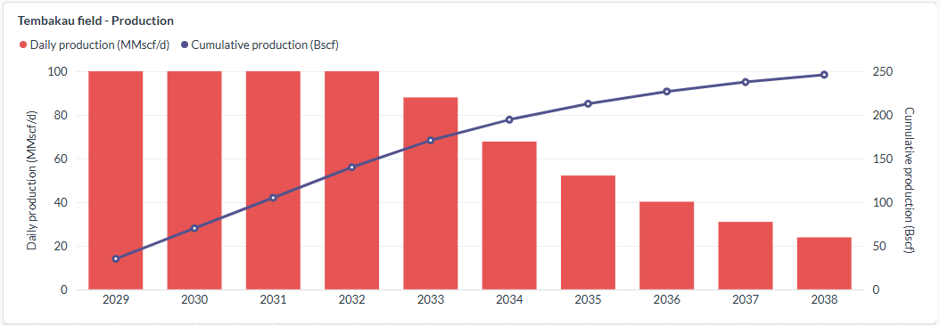
The required delivery pressure at the tie-in point may limit some of the later production. We have no data on this, so have assumed the recovery of the full 2C resource.
Our development model & costs
We have created a development plan and cost estimate based on the visible information, with assumptions used where the data is unknown. The image below shows the basis of our development.
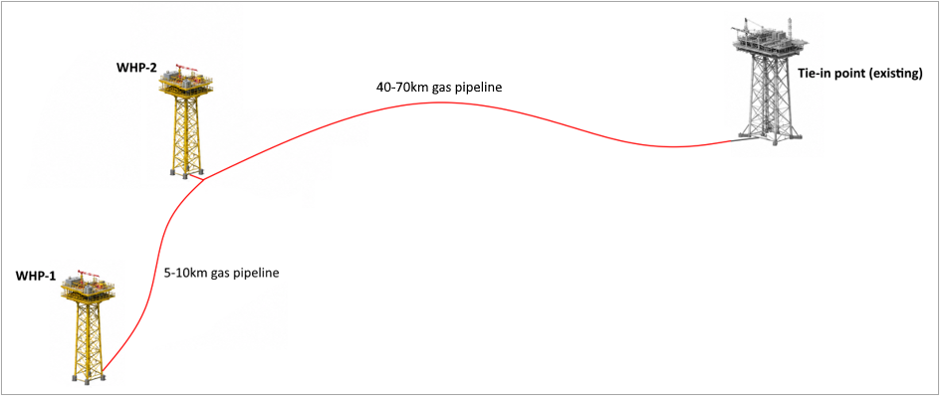
We have assumed a total of 4-6 production wells (two or three at each platform), with a CAPEX breakdown given below:
- Wells / drilling = $15 million per well
- Wellhead platforms = $30-45 million per platform
- Pipelines = $80-120 million
We have used these costs to create three CAPEX cases, as set out in the table below:
|
MM USD (Real 2026) |
Low |
Base |
High |
|
Well count |
4 |
5 |
6 |
|
Well cost |
$60 |
$75 |
$90 |
|
Wellhead platform |
$60 |
$75 |
$90 |
|
Pipelines |
$80 |
$100 |
$120 |
|
Total CAPEX |
$200 |
$250 |
$300 |
In addition, we have allowed for additional owner’s costs at 10% of the total CAPEX.
The OPEX requirements are limited as the platforms are unmanned, so we have assumed that all of the operating costs are fixed. For ABEX, we have assumed 20% of the CAPEX. The OPEX and ABEX costs for the three cases are shown in the table below:
|
MM USD (Real 2026) |
Low |
Base |
High |
|
Annual OPEX |
$10 |
$15 |
$20 |
|
ABEX |
$40 |
$50 |
$60 |
Gas price
The gas price in Malaysia is generally based on the Malaysian Reference Price (MRP), which represents the weighted average price (WAP) of liquefied natural gas (LNG) on a free-on-board basis (FOB Basis) that is exported out of Malaysia. As of March 2026, the MRP is RM 31.92/MMBTU, or about US$7.8/MMBTU.
However, whilst this is the marker price, upstream projects will realise a percentage of this price that can depend on a number of factors, with Peninsular Malaysia projects typically realising a gas price of 50-65% of MRP (about US $3.9–5.1/MMBTU).
This would be realised at Kerteh. Therefore, we will also need to allow for a tariff for using the third-party infrastructure. Given there are no confirmed details of either the tie-in point or the tariff, we have simplified our model by assuming a point of sale at the tie-in point, with our gas price therefore implied as the Kerteh price minus the tariff. Given the unknowns, we have run the model for a range of gas prices from US $2/Mcf to $5/Mcf.
Development economics
We have run the low, base and high cost scenarios through our DCF model at the four different gas prices, with the resulting NPV10 and IRR shown in the charts below:
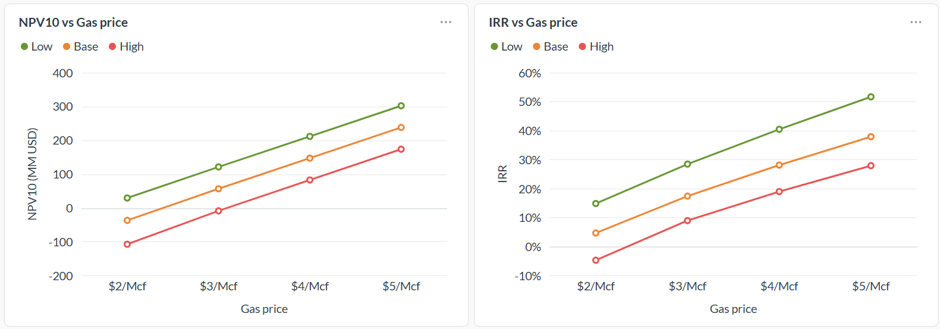
From the above charts, we can interpolate the breakeven gas price for the three cost cases:
- Low = $1.6/Mcf
- Base = $2.4/Mcf
- High = $3.1/Mcf
Taking a closer look at the NPV chart, we can see one of the design aspects of the SFA terms. As there is no cost recovery mechanism, any savings that can be made in the project’s costs are almost entirely to the benefit of the contractor. Therefore, contractors will be very motivated to find innovative and low-cost solutions, with Seascape reporting that it hoped the platforms could be installed by the jack-up drilling rig (rather than bringing in a dedicated lift vessel).
Why invest
- The Tembakau field has certified 2C resource of 246 Bcf.
- There is identified exploration upside, both within the Temaris Cluster PSC and in contiguous exploration acreage.
- Peninsular Malaysia has a clear need for additional gas supply, and PETRONAS has framed Temaris as supportive of Malaysia’s energy security.
- The field can be developed quickly, with both Seascape and the regulator pushing for this.
- The facilities required for the development are minimal and well proven, with development CAPEX of around US$4.8–7.3/boe before owner’s costs and ABEX.
- The Seascape team has a strong regional track record through previous companies and has established itself in Malaysia.
- The illustrative economics look attractive, particularly if costs can be managed and a reasonable realised gas price can be secured.
- Depending on the farm-in structure, a partner may be able to take a material technical or operating role, although Seascape has not publicly disclosed the range of structures under discussion.
- Seascape is also progressing the debt-financing route, with Macquarie mandated to structure a potential multi-tranche facility for Temaris and DEWA.
The challenges and unknowns
- There are some key unknowns still including the tie-in point and the gas price.
- Seascape does not currently have producing operations. If Seascape remains operator, this would be its first step into production operations.
- Seascape is targeting FDAP submission by the end of 2026, consistent with the 18-month timeline disclosed at award. Until that is submitted and approved, the development schedule remains one of the key execution risks.
- Debt financing has not yet been secured. Macquarie has been mandated to structure and arrange potential facilities, but any firm financing remains subject to due diligence and internal approvals.
Summary
Seascape has clear momentum, and Temaris could become its first producing asset if the development plan, gas price and tie-in arrangements come together. Seascape has a strong team with deep regional knowledge and excellent relationships with the regulator.
I won’t comment on the subsurface but, from the facilities development perspective the development is simple. The shallow-water setting should leave a relatively broad contractor market for the jack-up rig, wellhead platforms and pipeline.
There are some unknowns, but these could be managed through a contingent payment structure.